
The EARN Standard
The basketball language coaches trust. Movements, reads, spacing, screens, and decisions athletes can carry into any team, any coach, and any system.

What is the EARN Standard?
When your teammate drives, do you lift, drift, or cut?
The EARN Standard gives you the language to make that read. It’s the basketball language Coach Ant installs in every athlete who comes through the EARN stage. It’s not a drill pack. It’s not a highlight tape. It’s the vocabulary of winning basketball: where to stand, what to read, how to set and use a screen, how to move without the ball.
This is not random skill work. This is the standard.
Talent might get an athlete noticed. Basketball understanding earns trust.
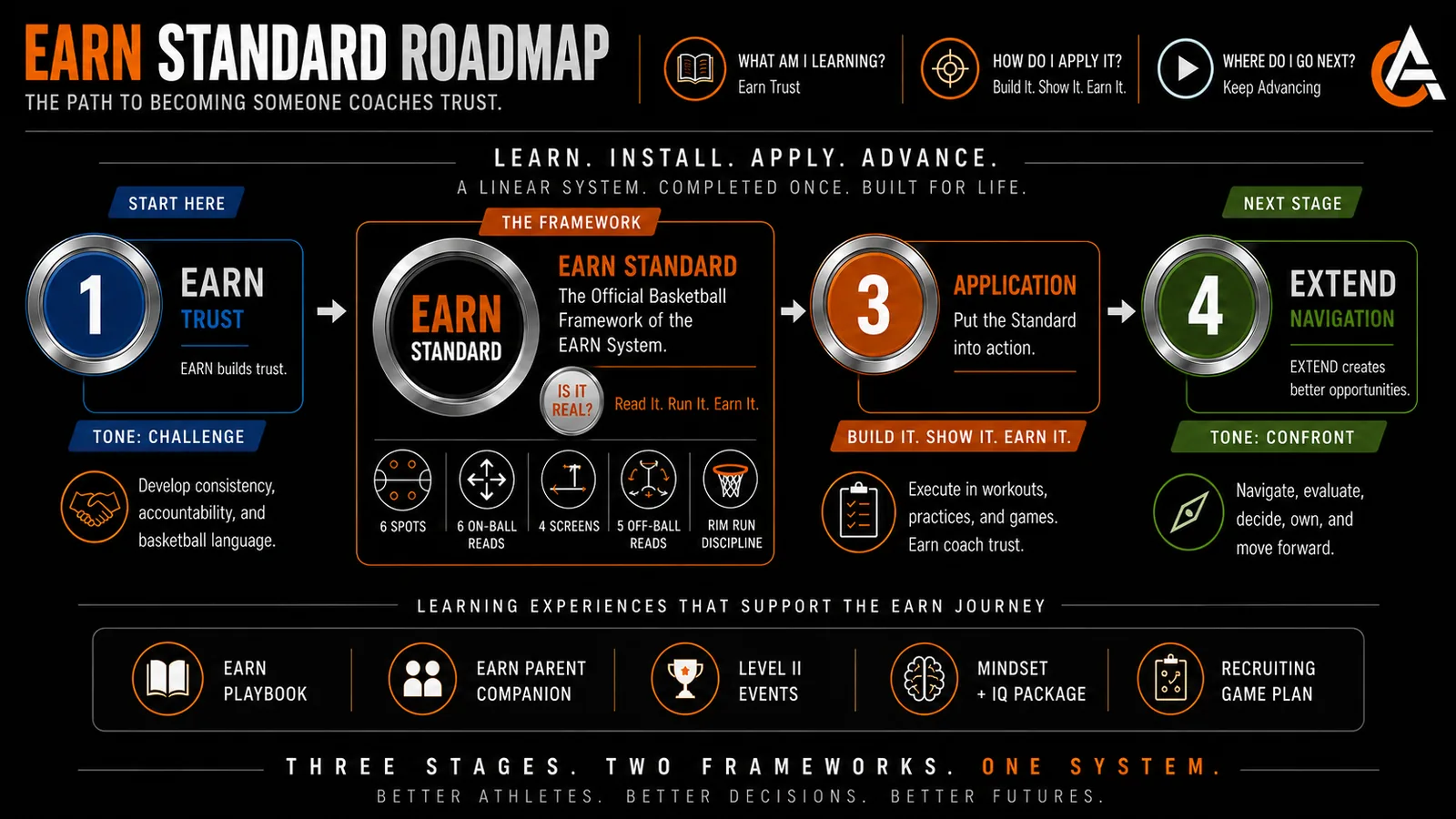

The EARN install
Installed in order. Every layer builds on the one before it.
6 Spots, 6 on-ball reads, 4 screens, 5 off-ball reads, and rim run discipline. Then athletes apply it in live team basketball.
Jump to the Standard

01 · Foundation
The Six Spots
Every spot on the floor has a job. Athletes who don’t know their spot can’t be trusted with the ball.
- Nail
- Top
- Right 45
- Right Corner
- Left Corner
- Left 45

02 · Decision making
The EARN 6: on-ball reads
Every ball screen creates a question. The EARN 6 teaches athletes to recognize the defensive answer before deciding on the offensive response.
Athletes learn six common defensive reactions and the right basketball decision for each. They don’t memorize plays. They read what the defense gives them.
03 · Screen game
The Four Screens
Four screen actions. Athletes learn to set them, read them, and use them.
Different screens create different advantages. Athletes learn when to use each one, not just how to run it.
04 · Movement
The Off-Ball Five
Most athletes stop playing after they pass. Trusted athletes know the next action. The Off-Ball Five keeps pressure on the defense even without the ball.
- Face Cut
- Backdoor
- Relocation
- Lift / Hold / Drop
- Off-Ball Screen
Basketball doesn’t stop when the ball leaves your hands. Neither should the athlete.
05 · Transition
Rim Run Discipline
Transition isn’t just about speed. It’s about spacing. Every fast break fills five lanes: Right Wing, Right Alley, the Rim Runner Lane, Left Alley, Left Wing.
The Rim Runner Lane is the most disciplined job in transition: run it, occupy the rim, and create the spacing everyone else depends on.
It’s the difference between easy buckets and a stalled half-court possession.

Learn to think the game, not just play it.
Athletes spend years on their handle, their shot, their athleticism. Almost none spend time learning the language of the game. That gap keeps talented athletes on the bench while more prepared athletes play. The EARN Standard closes it.
- Read screens
- Create advantages
- Move without the ball
- Keep offensive actions alive
- Understand spacing
- Grow basketball IQ
- Become easier to coach
- Earn more trust
For parents
A better way to see development.
Most parents judge progress by points, minutes, and highlights. Try this instead: watch what your athlete does before the ball arrives. Do they recognize the coverage, find the open space, and give a teammate an option?
They stop asking, “Did my athlete score?” They start asking:
- Did they make the right read?
- Did they create an advantage?
- Did they earn more trust today?
How it fits the system
Not a separate stage. The language of EARN.
The EARN Standard is the language every athlete installs while earning trust. It’s proof they understand the game, not just that they can perform in it.
- BUILD the foundation.
- EARN the trust.
- Install the Standard.
- Apply it.
- EXTEND what you understand into real decisions.

Learn the language. Master the Standard. Earn the trust.
Coaches don’t trust athletes because they know every play. They trust athletes who understand the game.